
Payment infrastructure rarely gets the scrutiny it deserves during vendor selection, yet a 2026 Federal Reserve Bank of Kansas City briefing shows why that's a mistake. Between 2021 and 2023, the fraud loss rate merchants absorbed on card-not-present debit transactions over single-message networks more than doubled, climbing from 5.4 to 12.8 basis points. Numbers like that are exactly why the choice of SaaS payment solutions deserves more than a quick fee comparison.
Most evaluation checklists focus on processing rates and setup speed. Few ask how a provider handles failed charges, compliance scope, or international payment rails – the three areas where a weak SaaS payment solution quietly erodes revenue long after the contract is signed.
Why Failed Payments Cost More Than They Appear To
A missed charge looks like a minor technical hiccup. In aggregate, it behaves more like a slow leak in recurring revenue, and it's one of the clearest arguments for treating SaaS payment solutions as a strategic decision rather than a procurement afterthought.
What Is Involuntary Churn?
Involuntary churn is a cancellation caused by a failed payment rather than a customer's deliberate decision to leave. A card expires, a bank flags a routine charge as suspicious, a billing update never makes it into the account – the subscriber didn't choose to stop paying, they just got locked out.
The same Kansas City Fed briefing points to a broader shift worth noting here too. Card-not-present fraud rates on single-message debit networks (think Star, NYCE, Pulse) climbed by more than 10 basis points between 2021 and 2023, overtaking dual-message networks like Visa and Mastercard for the first time on record. Fraud filters get tuned more aggressively in response, and aggressive filters catch legitimate renewals along with the bad actors. Comparing payment solutions for SaaS on transaction fees alone misses this entirely.
Most failed charges trace back to a short list of causes:
Expired or reissued cards that never got updated on file
Issuer-side declines from overcautious fraud filters
Insufficient funds at the moment a recurring charge hits
Currency or network mismatches on cross-border transactions
A payment solution for SaaS built with automated card-updater support and staged retries tends to win back a noticeably larger share of these failures than one that fires off a single retry and gives up. That difference alone can be worth watching closely during vendor evaluation. Not every provider markets itself this way, which is exactly why the recovery mechanics of any SaaS payment solution deserve a direct question rather than an assumption.
How Compliance Requirements Shape Vendor Choice
Security compliance isn't optional, and it isn't handled the same way by every provider offering SaaS payment solutions.
What Does PCI DSS Actually Require?
PCI DSS is a security standard maintained by the PCI Security Standards Council, and it applies to any business that stores, processes, or transmits cardholder data. A meaningful chunk of that standard only recently became fully enforceable: 51 of the 64 new requirements introduced in PCI DSS v4.x had been treated as optional best practices, and they only became mandatory for assessments on March 31, 2025. Providers that were slow to adopt those controls are, technically, still catching up.
Routing transactions through a well-known processor doesn't automatically satisfy these obligations. Compliance scope depends on how much card data actually touches internal systems – a setup where raw numbers never reach company servers keeps the audit surface small, while custom-built card handling expands it considerably. That's the kind of detail worth confirming before signing on with any payment solution for SaaS, since it changes the ongoing audit workload as much as it changes the initial setup.
A handful of structural choices tend to keep both risk and audit overhead in check:
Hosted payment fields or tokenization, so cardholder data stays with the processor
Fraud detection and chargeback tooling built into the platform rather than bolted on afterward
Documented scope reduction as part of the provider's own PCI attestation
Why Local Payment Coverage Matters for Global Growth
Expansion plans tend to assume a payment stack built for one region extends naturally to the next. That assumption falls apart pretty fast outside markets where card networks dominate.
Which Markets Need Local Payment Methods?
Regions with lower card penetration – parts of Southeast Asia, Latin America, and the Middle East among them – often lean on local bank transfers, e-wallets, or delayed-debit schemes instead of international card rails. It's not that a subscriber in one of these markets picks a competitor. Checkout simply never completes, because there's no supported way to pay.
That's the part that makes comparing SaaS payment solutions on domestic transaction fees alone a little misleading. A provider that looks cheap for a U.S. customer can turn out to be practically unusable for the next few markets on an expansion roadmap, which is why local rail coverage belongs on the same checklist as pricing when a company is choosing a SaaS payment solution for the first time.
Comparing Payment Setups Side by Side
Structural gaps between a narrow setup and a flexible one tend to show up gradually, usually right when a company needs to move fast. The table below outlines where most SaaS payment solutions diverge in practice.
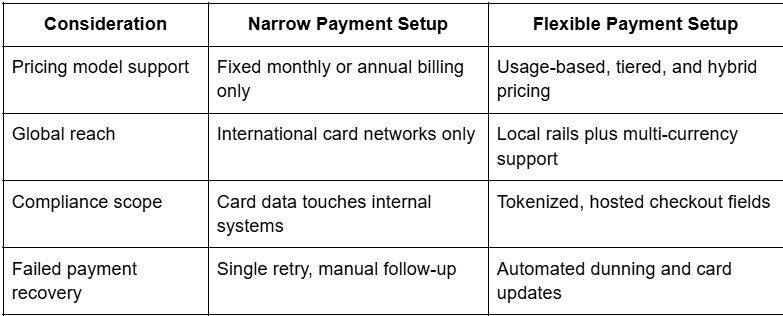
None of these gaps are visible during a demo. They surface later – usually when finance, sales, or product runs into a limitation nobody flagged when the contract was signed.
Frequently Asked Questions
What makes a SaaS payment solution different from a general e-commerce payment gateway?
Recurring billing logic is the main difference – proration, subscription upgrades, usage-based charges, dunning workflows. General e-commerce gateways handle a single sale well but weren't built for the kind of billing complexity subscription businesses deal with day to day, which is precisely the gap SaaS payment solutions are designed to close.
How much does PCI DSS compliance affect a SaaS company's payment stack?
Quite a bit, both in design and in cost. Scope is the deciding factor: the more cardholder data that touches internal infrastructure, the heavier the compliance burden ends up being for whichever payment solution for SaaS a company has chosen.
Is involuntary churn something a SaaS company can actually reduce?
For the most part, yes. Most of it comes down to fixable technical causes – an expired card, a declined charge – rather than genuine dissatisfaction, and tools like automated card updates and staged retries were built specifically to catch those cases before they turn into a lost customer.
Do small SaaS companies need to worry about international payment methods this early?
Not right away, but it's worth having on the radar the moment expansion into new regions starts getting discussed. Planning for local payment rails ahead of time tends to be a lot less painful than rebuilding a SaaS payment solution after the fact.
What's the biggest mistake companies make when comparing payment solutions for SaaS?
Anchoring the whole decision to the headline processing rate. Failed-payment recovery, compliance scope, and billing flexibility usually end up mattering more to the bottom line than a fraction of a percentage point in transaction fees – which is really the core argument for evaluating SaaS payment solutions on more than price alone.